



Have any questions? We are happy to answer
Parents Register here
Teachers Register here
Institutions Apply here
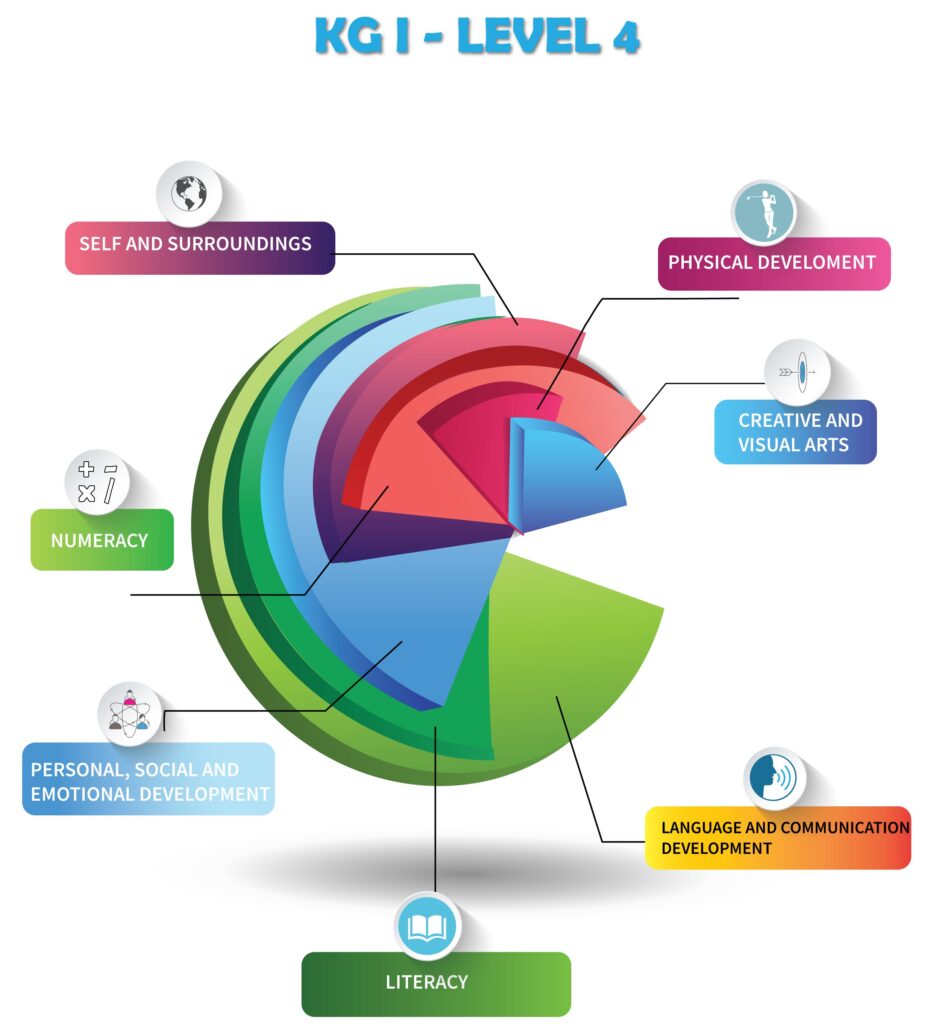
Children are offered a well-designed and balanced curriculum which takes them to a higher level in learning and literacy, with inbuilt programmes for socio emotional, physical and aesthetic development. Practical lessons on concepts of self, nation and the world around.
LANGUAGE AND COMMUNICATION DEVELOPMENT
As language develops, children become conscious of their
communication skills. They can comprehend and follow directions and
express views and narrate stories. An increase in Phonological
awareness is also observed.
PERSONAL, SOCIAL AND EMOTIONAL DEVELOPMENT
Interpersonal Skills
We focus on encouraging communication and emotional skills in children to build self confidence in social skills and public speaking.
Intrapersonal or Emotional Skills
Creating awareness of self-regulation and encouraging children to talk about themselves and feelings. We also mentor them towards expressing their feelings.
Self Care Activities
At this level, we encourage children to maintain personal hygiene and cultivate healthy and good habits.
PHYSICAL DEVELOPMENT
KINESTHETIC AND GROSS MOTOR SKILLS
At this stage children are able to run in alternate directions and stop
suddenly without losing their balance. Promoting ‘Gross motor’ skills
help develop confidence. Large movements and activities make
children aware of their physical fitness and good health. Dance,
naturally inculcates an interest in music and promotes rhythmic
movements.
THE CONCEPT OF SELF AND SURROUNDINGS
Children approach new situations differently and exhibit strong
curiosity and clarify their thoughts. Provide objects and projects to
keep their fascinations growing by giving them time, space and
freedom to explore using their sensorial domains. Hands on
experience through activities builds awareness of one’s self, family,
environment and things in the environment.
FINE MOTOR SKILLS
Fine motor development is crucial as children learn to perform morecomplex movements. These are found to be motivating and fun and involve small muscle movements of the hands and fingers.For example: Activities like writing, eating, drawing, dressing and so on that coordinate with their eyes.
COGNITIVE OR INTELLECTUAL SKILLS
At this age children start questioning, have increased attention span,visual discrimination, and understand the concept of cause and effect and simple reasoning.
NUMERACY
Introduction to numbers begins with counting, recognising and writing symbols and associating a symbol with a name. Children learn to recognise and create patterns and shapes. They acquire higherlearning to understand number positions at this stage.
LITERACY
The process of reading and writing involve different skills. Children are aware that writing can be a way to communicate. They are motivated to write on their own. This is an age where they graduate to actual letters and words. Phonological awareness leads to an interest and desire to reading for themselves.
CREATIVE AND VISUAL ARTS
AESTHETIC SKILLS
Visual arts, craft, music, sounds and dance help develop creativity and
imagination in children through discovery, experience and exploration.
Arts help them at various levels of emotional, physical, mental and
social growth. Creativity helps to communicate feelings and provide
encouragement to participate in the activity irrespective of the
outcome.
OBJECTIVES
- Building values in children.
- Improving communication skills
- Bringing up independent and responsible children.
- Positive disciplining.
- Helping children to socialize .
By the end of the program children should be able to:
- Communicate with teachers and peer group.
- Follow instructions.
- Express wants and needs.
- Recognize and write Capital and Small Letters Aa-Zz.
- Identify letters to phonic sounds.
- Identify and write the vowels and consonants.
- Read and write two letter sight words.
- Blend and write short vowel {two letter and three letter} words with phonic sounds.
- Recite Nursery Rhymes.
- Narrate and answer questions related to stories.
- Recite Numbers 1 – 100 and Write Numbers in order 1- 50.
- Read and write Number Names – One (1) – Twenty (20) Understand Numeracy concepts- comparison, sets, odd one out, serration, number positions (after, before and in between), and missing numbers.
- Be Aware of concepts of self and surroundings.
- Actively participate in Dance, Art and Kinesthetic activities.